
On our first morning in Assisi, my wife Lili and I woke up at 6:30 AM. I opened the window of our second-floor room at Hotel Sorella Luna. A gentle breeze of cool, fresh air came in, and a spectacular vista spread out before me. Below, Via Frate Elia meandered uphill, and shop owners began to open their doors. As a group of early pilgrims made their way to the Basilica of St. Francis, their cheerful chatter lifted my spirits, even though I didn’t understand the language.
Across the street, the weathered, earth-colored roofs of stone houses transported me back to the 13th century, the time of St. Francis. Beyond them spread the lush Valley of Spoleto, dotted with farmhouses, church bell towers, and slender cypress trees. Far along the horizon, the Umbrian hills rested lazily on a band of soft fog as the morning sun tried to wake them up. The view was so mesmerizing, I couldn’t stop taking pictures.
Our Road to Assisi

We arrived in Assisi the day before, after a 5.5-hour journey on a fast Frecciarossa train from Venice to Florence and a slow regional train to Assisi. Starving by the time we arrived at 3 PM, I realized that our plan to walk to the hotel was too ambitious. Google Maps showed a 30-minute trek along a country road followed by a 15-minute uphill climb. Lili quickly vetoed the idea.
“What’s the alternative?” she asked.
“Well, a bus or a taxi,” I replied. We found the latter and hopped in for 15 Euros.
As we drove, the driver pointed up to the Basilica of St. Francis on the left, the Basilica of St. Clare on the right, and San Rufino Cathedral in between. “Near the cathedral is Piazza del Comune, downtown.”
Entering Assisi, he showed us the parking lot where tour buses and taxis gather, and I realized the people I’d seen walking in YouTube videos probably started their climb from there, not from the train station.
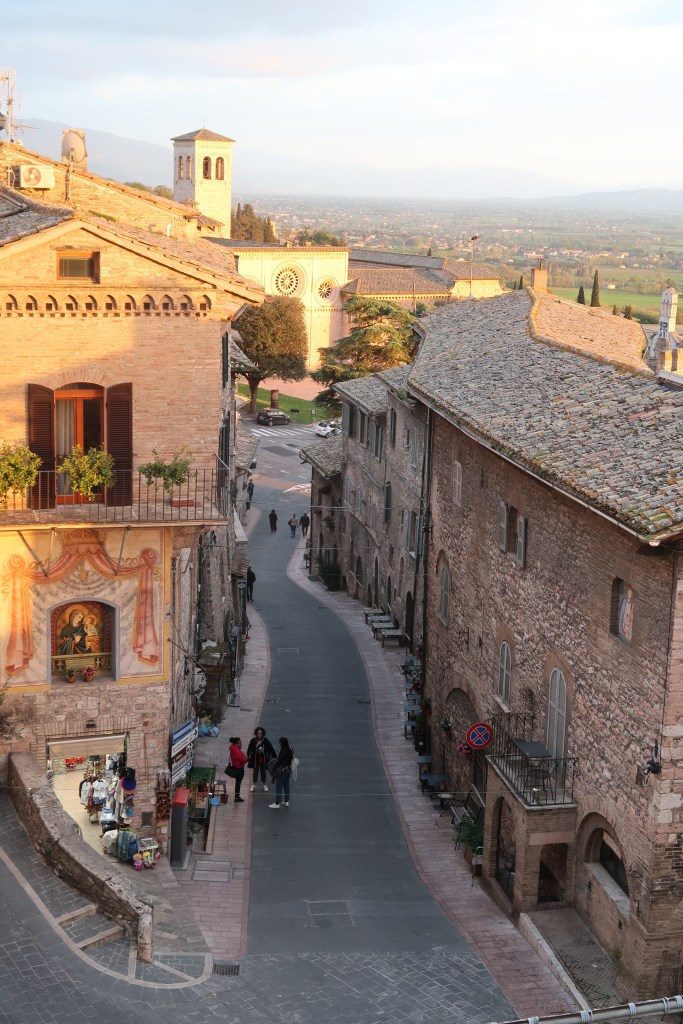
I picked Hotel Sorella Luna because of its proximity to the Basilica of St. Francis. Via Frate Elia, the steep, narrow street in front, is the main path to the basilica. Each morning, we watched pilgrims walk uphill, and in the evening, to the other direction. I loved the scene.
After checking in, Lili and I took a quick walk to the basilica. She couldn’t resist stopping at a few gift shops along the way, but eventually, we reached Piazza Inferiore, the wide Lower Plaza of the church with its distinctive white-pink-tan striped stone floor and two porticos with unending arches. There, at the far end, stood the majestic Basilica di San Francesco d’Assisi, just as I had seen in countless photos and videos.
By then, it was 4 PM, and we were famished. After a quick selfie, we set off in search of food, planning to return later to explore the basilica.
The City of Francis and Clare
The history of Assisi is deeply connected to Giovanni Francesco Bernardone (Francis) and Chiara Offreduccio (Clare), who founded the Franciscan movement in the late 12th and early 13th centuries. Both abandoned their comfortable upper middle-class lives to embrace poverty and follow the teachings of Jesus Christ, leaving a legacy that continues to inspire millions to this day.
But growing up in Indonesia, where Catholics make up a mere 3% of the population, I wasn’t familiar with these saints. The St. Francis most Indonesians know is St. Francis Xavier, the Jesuit missionary who traveled to the Far East, including Indonesia, in the 16th century. My first “encounter” with St. Francis of Assisi was during a Christmas trip to San Francisco in 1992, though it wasn’t until years later that I learned the city was named after the Italian saint.
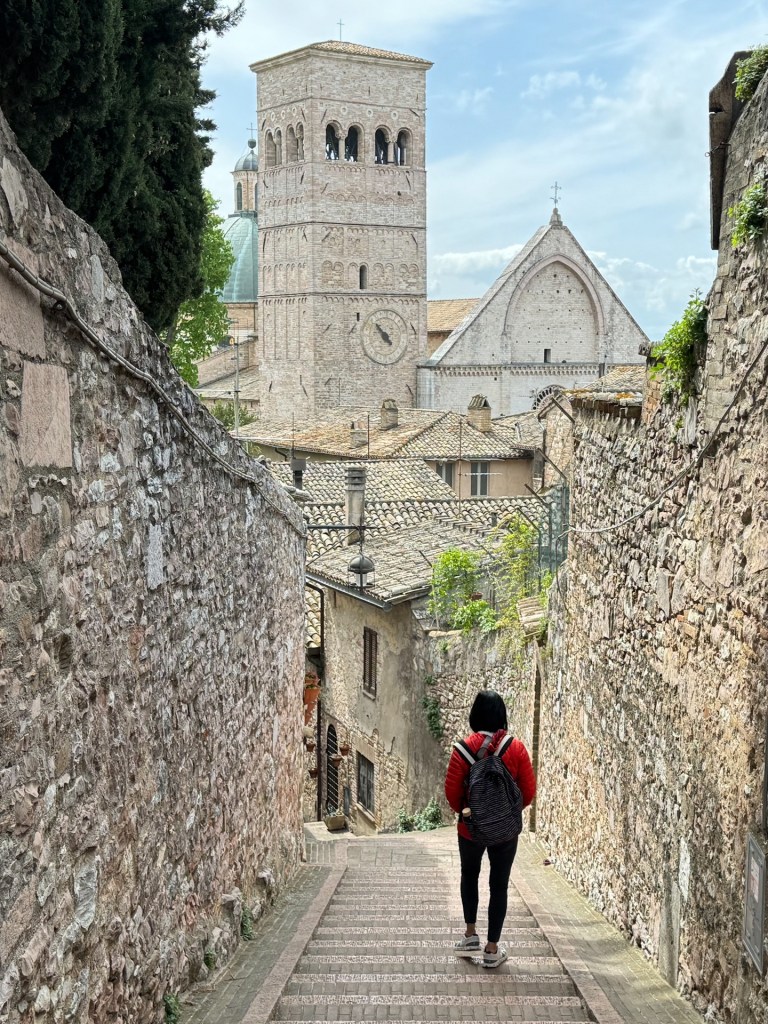
After moving to Frisco, Texas, in 1995 and attending St. Francis of Assisi Catholic Church, I gradually started learning about St. Francis. By 2018, when my son Martin married his wife Claire at St. Clare Chapel, my admiration for these saints had deepened. So, when planning our first trip to Italy, I decided to forgo Florence and spend three nights in Assisi instead—a decision we didn’t regret.
During our time in Assisi, we visited many pilgrimage sites that hold significance in the lives of the two saints. These sites draw 4-5 million of visitors to Assisi annually, although many come just for a day trip.
Basilica of St. Clare
On our first afternoon, after a quick bite, Lili and I walked to the Basilica di Santa Chiara, built between 1257 and 1260 to honor St. Clare. Inside, we prayed in front of the San Damiano Crucifix, the very cross from which Jesus spoke to Francis, asking him to “repair My church which is in ruins.” St. Francis Church in Frisco has a huge replica of that wooden cross hanging behind the altar, and now I was delighted to see the original one.
We then visited the crypt where St. Clare’s remains rest and the small museum that displays the simple, hand-sewn garments that she made for herself and Francis.
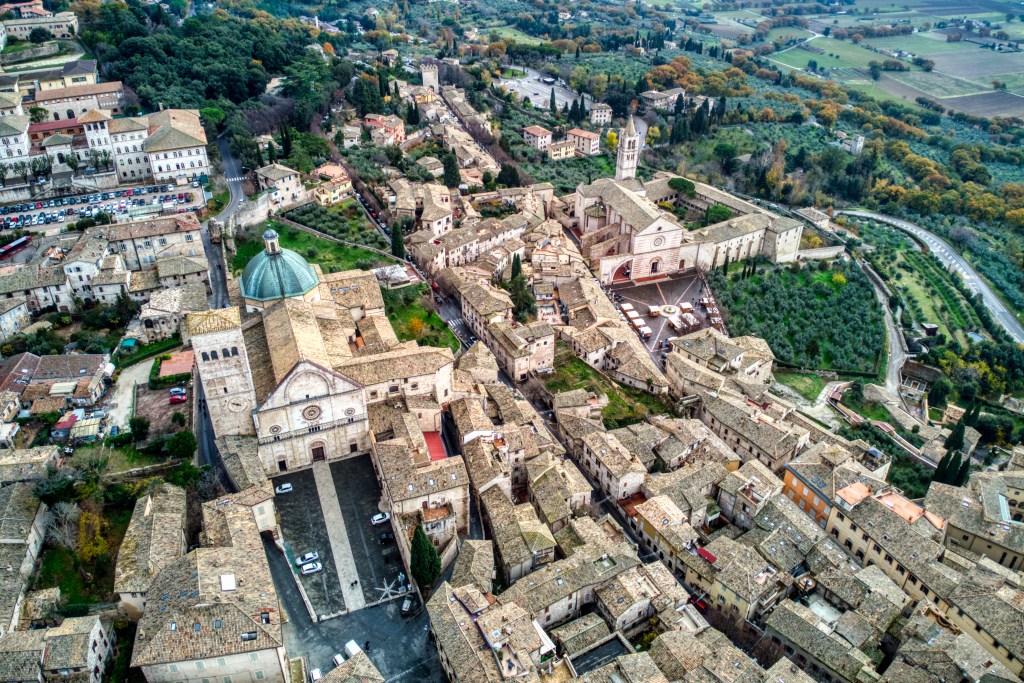
Outside, we sat on a plaza bench, soaking in the serene view of the olive groves on the hillside and the basilica’s pink and white facade, made from stones of Mt. Subasio, the mountain behind Assisi that featured prominently in Francis’ life.
Portiuncula
At 9 the next morning, we met Maura Baldoni, our tour guide, in the hotel lobby. I had found her through Tripadvisor and booked “Assisi and Saint Francis – A Mystic Guided Tour,” a 3-hour private tour of the pilgrimage sites around (but outside of) Assisi.
Our first stop was the Basilica di Santa Maria degli Angeli, located in the valley 4 km southwest of Assisi. It was built over the small chapel of Portiuncula, one of the three churches Francis restored by hand. This humble chapel, now encased within the massive basilica, was where Francis fully understood his mission: to renew the faith of the Christian Church, not its buildings. It became the place that he loved the most.
San Damiano
Had we followed Francis’ life chronologically, San Damiano would have been our first stop. Set on a hilltop just below Assisi, San Damino – like Portiuncula – was a ruinous chapel in his time.
On one spring day in 1206, Francis impulsively went into San Damiano, and as he prayed, Jesus spoke to him from the cross (the one now known as San Damiano Crucifix). This was the starting point of Francis’s spiritual journey.

San Damiano later became the convent for St. Clare and her followers, the Poor Clares nuns. The simplicity and austerity of their lives were evident in the bare dormitory and refectory, where they lived joyfully in poverty.
Eremo delle Carceri

Our third stop was Eremo delle Carceri, a remote hermitage perched on Mt. Subasio. Surrounded by old oak trees, the hermitage was built around a cave where Francis and his closest brothers often came to pray and contemplate in solitude. The Latin word “carcer” means “remote, solitary, suitable for a life of prayer,” and it pretty much describes the place atmosphere. During our visit, we saw only one other visitor, one Franciscan friar in his distinctive brown habit, and three workers. It is indeed a tranquil place where one can get lost in prayer and nature.
Basilica of St. Francis
That afternoon, we explored the Basilica of St. Francis, a UNESCO World Heritage site. It is one of those places that make you stand in awe and say, “Wow!”
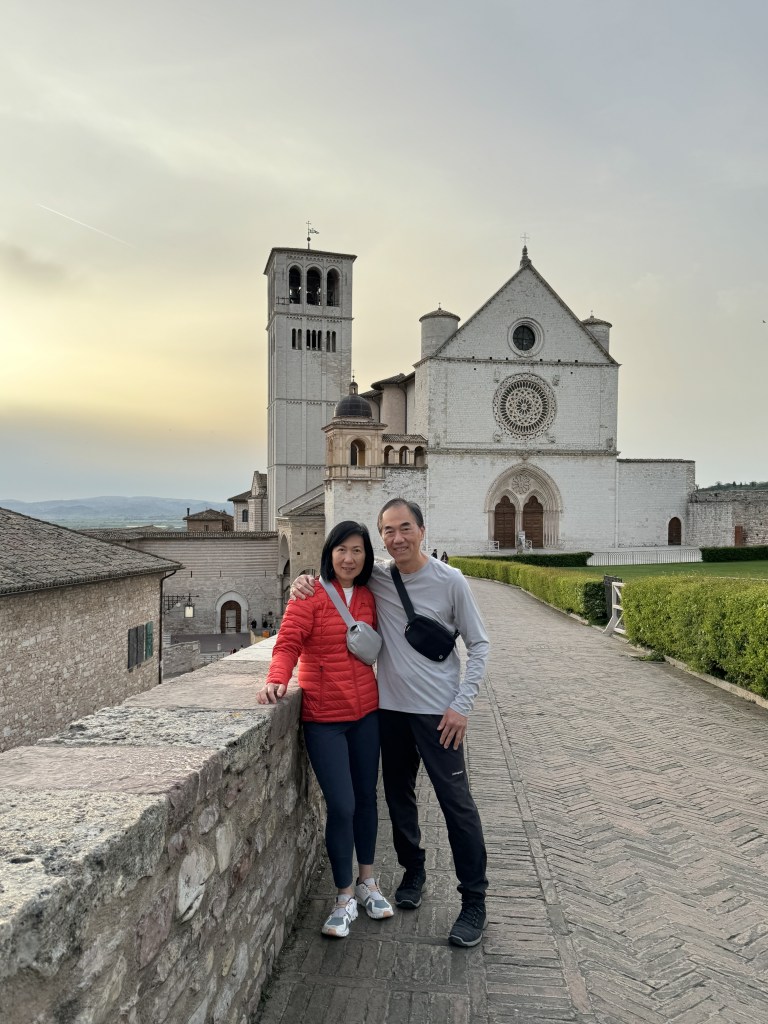
The Lower Church, built in 1228-1230, shortly after Francis’s death, and the Upper Church, added in 1239-1253, are both adorned with stunning frescoes by masters like Cimabue and Giotto. Many people have said that a grandiose building would have been the last place Francis wanted to be buried at. While that may be true, if the magnificent basilica wins over hearts to the Lord – which I believe it does – then I think Francis would take a consolation in that.
We visited the crypt where Francis is buried, surrounded by his four closest companions (Brothers Rufino, Angelo, Masseo, and Leo), and took time to pray in the peaceful atmosphere.
Throughout our stay, we returned to the basilica (and the Gift Shop) several times, even attending daily evening Mass twice in the St. Catherine of Alexandria chapel. Though the service was in Italian, we could follow along because the Catholic Mass structure everywhere in the world is the same, and it was a deeply moving experience to worship in such a holy place. We felt profoundly blessed to be there.
The City of Peace
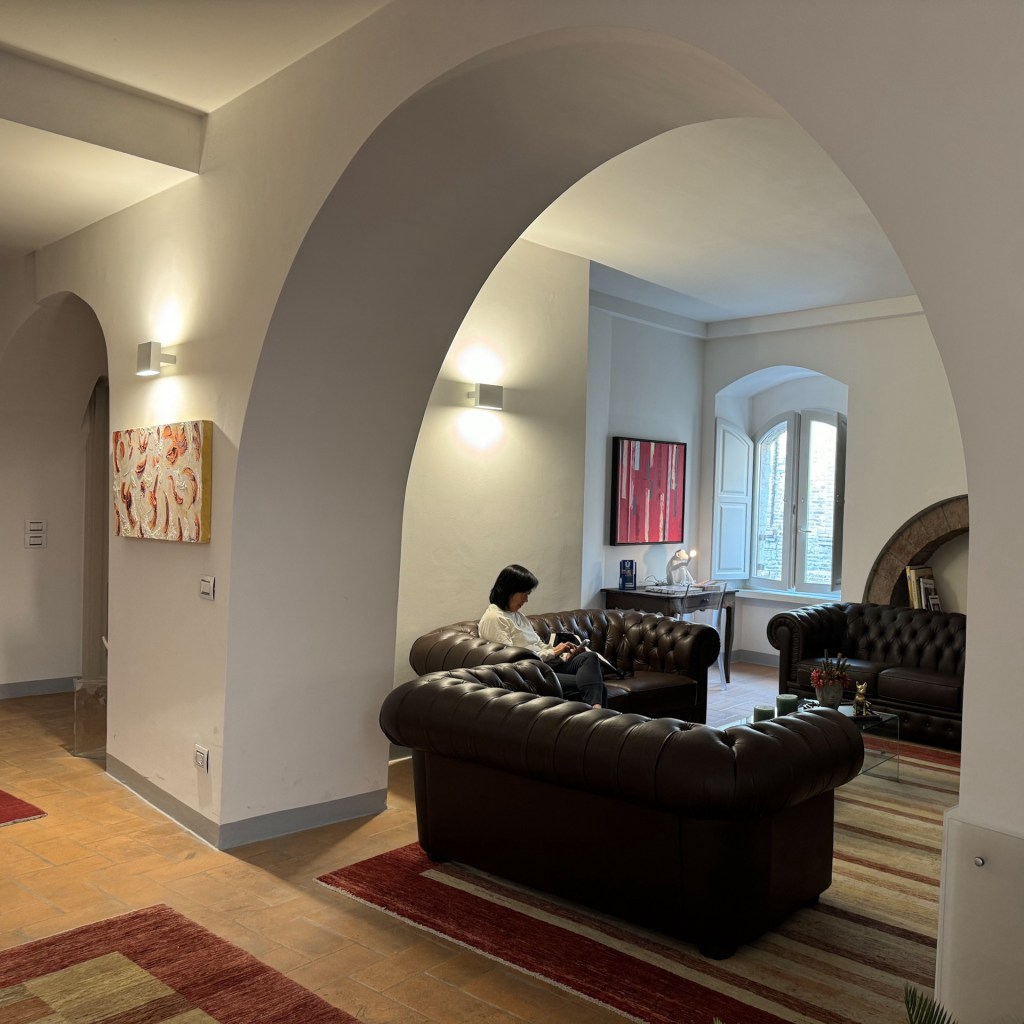
What if you’re not Catholic or even Christian? Would you still enjoy Assisi? Absolutely. If you like a peaceful and relaxing getaway, Assisi has plenty to offer. During our time there, Lili and I walked, hiked, enjoyed delicious meals, admired local art, and browsed through charming gift shops.
Walking
For us, strolling through the ancient, narrow streets of Assisi felt like a vacation in itself. We were there just after Easter, and the streets were soothingly uncrowded, a stark contrast to the bustling alleys of Venice. The temperature ranged from 11⁰C (52⁰F) in the morning to 22⁰C (72⁰F) in the afternoon, making it a very pleasant experience overall.
Over two and a half days, Lili and I wandered up and down the streets of Assisi, falling in love with the town’s charm. From our hotel on the western edge, we’d walk east along Via Fontebella, a one-way street lined with cappuccino-colored buildings and small gift shops.

At the end of Via Portico, Piazza del Comune greeted us. This small “downtown” is decorated with the seemingly out-of-place Temple of Minerva at one end and an octagonal fountain on the other end. Along its long sides are restaurants with inviting outdoor seating places. As importantly, the plaza also housed a much-needed ATM that didn’t belong to the fee-heavy Euronet network.
Continuing east, we reached the Basilica of St. Clare and then Porta Nuova, one of Assisi’s eight historic gates. We often retraced our steps back to the hotel via the “upper” roads—Via San Francesco or Via Metastasio—both of which end near the Basilica of St. Francis’ Upper Church.

These streets of Assisi were a feast for the eyes and a good workout for our feet.
Dining
One of our favorite dining experiences was at Le Terrazze di Properzio, a restaurant we stumbled upon along Via Metastasio. After checking a few other places that didn’t quite appeal to us, we decided to try this one, which had an excellent 4.7 stars on Google. Without a reservation, we were lucky to get a table on the upper terrace, where we enjoyed a magnificent view of the city and valley, bathed in the golden light of sunset.

The dinner was memorable, with our favorite dish being the carpaccio di black angus affumicato (smoked black Angus with valerian, orange, olives, pecorino cheese, and cherry tomatoes). Lili loved it so much she vowed to order it again if we ever returned.
Another gem we found was Ristorante Foro Romano, a quick, friendly, and inexpensive spot just a short walk from Piazza del Comune. We were so happy with their lasagna, pasta, and desserts that just before they closed at 4 PM, we bought some food to take back to our hotel for dinner on our last day.
Hiking
Though we had considered visiting nearby towns like Spello or Perugia, we loved Assisi so much that we decided to stay put and hike to Rocca Maggiore, an imposing fortress above the town. The 1.5 km (0.9 mile) hike took us through picturesque backstreets and a path through an olive forest.
With photo stops along the way, the hike took about 1.5 hours, but the sweeping views of San Rufino Cathedral, Basilica of St. Clare, and the green countryside from the hilltop were well worth it. The chime of church bells added to the charm.

The 8€ entrance fee to Rocca Maggiore was worth it. We explored the fortress’s various spaces and were rewarded with panoramic views in all directions. Our final “exercise” was a walk through a narrow tunnel to the Polygonal Tower, where we enjoyed a breathtaking view of the Basilica of St. Francis from above. It stands like a lasting refuge over the ever-changing world below.
Shopping
Assisi’s gift shops are plentiful but not overwhelming. Most of the shopkeepers are friendly, allowing you to browse at your leisure. Naturally, many shops sell religious souvenirs related to St. Francis and St. Clare, though prices vary, so it’s wise to compare before buying. We found that the Basilica of St. Francis Gift Shop generally had better prices.

We also visited two artisan shops. One was La Bottega Acquerelli, a historic shop that sells frescoes, watercolors on ceramic, etc., handmade by local artists, from where I bought a small ceramic depicting the famous scene of Francis preaching to the birds. From the painting, I could almost hear his words. “My little bird sisters, you owe so much to God your Creator. You must always and everywhere praise Him, because He has given you freedom to fly anywhere …” Perhaps he was talking to me, too.
The other shop was Massimo Cruciani’s glass painting studio, where his vibrant depictions of Assisi and Umbria landscapers captivated us. Even though we didn’t buy anything, it was a delightful and unique experience.
Closing
In the summer of 1225, Francis – by then gravely ill and nearly blind – spent seven weeks recuperating in San Damiano, where Clare built a hut of reeds for him on the convent grounds. Despite his poor physical and living condition, Francis saw the beauty of nature and composed the now-famous Canticle of the Creatures, a poem praising the Lord and His creations. (Maura told us that until now, Italian students still study the Canticle in school.)
One line in the Canticle praises the moon and stars: “Laudato si’, mi’ Signore, per sora luna e le stelle, in celu l’ài formate clarite et pretiose et belle.” (“Praised be to you, my Lord, through Sister Moon and the stars, in heaven You formed them clear and precious and beautiful.”)
To borrow Francis’s words, I too found Assisi to be “precious and beautiful.” The beautiful scenery alone is reason enough to visit, but Assisi’s serene spiritual character makes the city also precious. May the Lord’s hands bring Lili and me back there one day.
References
- Basilica of St. Francis of Assisi website.
- Basilica of St. Clare of Assisi website.
- San Damiano Sanctuary website.
- Eremo delle Carceri Sanctuary website.
- Engelbert, O. (2013). St. Francis of Assisi: A Biography. Franciscan Media.
- Lonely Planet Italy Guidebook – 2020 edition.
Image source: unless otherwise noted, the photos in this article were taken by the author.
 REFLECTIONS ON LIFE, WORK, AND FAITH IN THE 21ST-CENTURY AMERICA
What a delight to find your blog, sir! Thank you for sharing. I’m also a first-generation immigrant, and this particular post is helping me plan the itinerary for a trip to Assisi with my growing family. My wife and I are millenials, and we plan to see the tomb of Bl. Carlo Acutis as well!
LikeLiked by 1 person