

There is a line in the book “A Pilgrimage to Eternity” by Timothy Egan that caught my attention last month. Quoting Ian Goldin, an Oxford professor, he wrote, “There’s never been a better time to be alive, yet we feel so glum. So many people feel anxious. So many people feel this is one of the most dangerous times.”
Prof. Goldin spoke those words in Davos, Switzerland, in 2017; that is, before the pandemic. But now that we have put the pandemic behind us, I am not sure if our manner has changed. In and around me, I hear worries. We worry about our and/or our family member’s health. We worry that the rising prices will put our dream “thing” (whatever it is) out of reach. We worry when we forget to bring our smartphones. We worry that our kids are taking the wrong direction in life, that our products will not be shipped on time, that rabbits will devour the plants in our garden, and this, and that. Mind you, my cohort and I are not living in an impoverished or war-torn country. We live in a wealthy metropolis in a peaceful country.

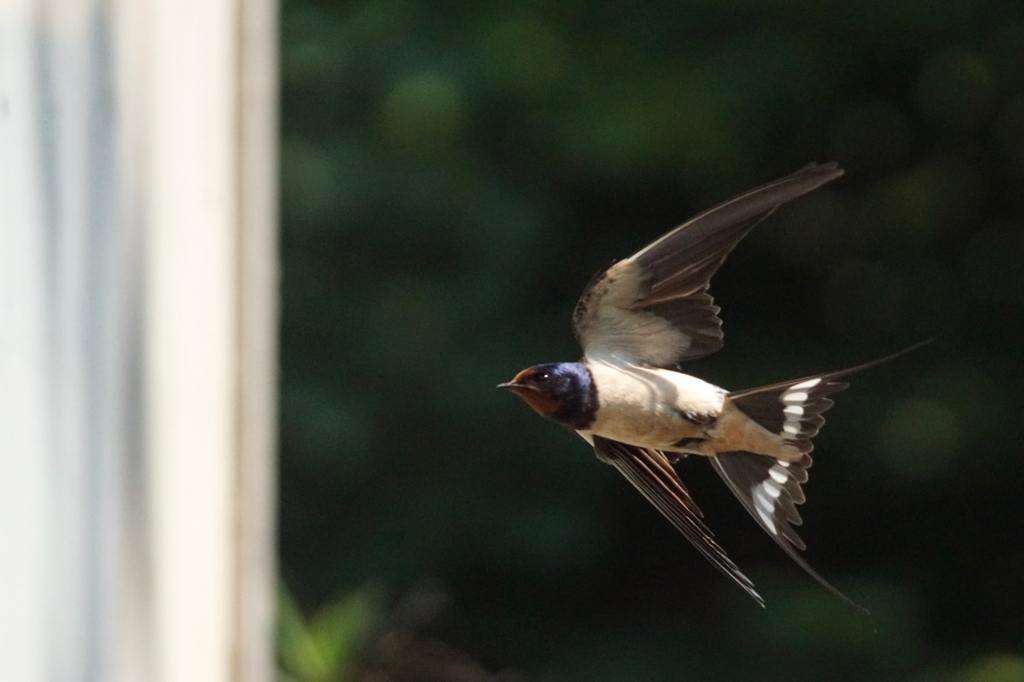
Speaking about rabbits, sometimes I wonder, do animals worry? I suppose domestic animals do once in a while, like our dog Bevo when he just moved into our new house two years ago. Having lived in the same house for 11 years prior to that, he clung to us to make sure we didn’t leave him in this “strange place.” But how about wild animals? Experts said chimpanzee and elephants do, but the small creatures around my house don’t seem to. For the second year in a row, a lovely couple of sparrows made a nest above our front door. During the day they would fly merrily here and there, presumably to earn their living. At night, both rest in the nest. (I don’t think they ever work overtime.) No wonder Christ used them as an example when he addressed the wary Israelis who – unlike me – did live in a tense time under Roman occupation 2,000 years ago.
“Are not five sparrows sold for two pennies? Yet not one of them is forgotten in God’s sight,” He said. “Therefore I tell you, do not worry about your life, what you will eat, or about your body, what you will wear. For life is more than food, and the body more than clothing. Consider the birds of the air: they neither sow nor reap, they have neither storehouse nor barn, and yet God feeds them. Of how much more value are you than the birds!” After all, he added, “Can any of you by worrying add a single hour to your span of life?”(Luke 12)
Indeed, if the past two years have taught us anything, it is that we cannot. Quite the contrary, anxiety increases our blood pressure and the risk of heart disease. But we all know that, don’t we, and we still worry. So, what should we do? Well, perhaps I can direct you to Dale Carnegie’s book “How to Stop Worrying and Start Living.” It was the first self-help book I’ve ever read, and so many years and books later, I still consider it as one of the best. But for now, let me just tell you one of the stories that Dale shared in the book. It was the story of his own parents.

Dale Carnegie grew up near Maryville in Missouri (about 96 miles (155 km) north of Kansas City) in the late 19th century. His parents were small farmers, and life was hard. “We rarely had any cash,” he wrote,” except once a year when we sold our hogs.” On one rare occasion, his father gave him ten cents (about $3.50 today) to spend, and he felt like a millionaire.
Year after year they had bad luck. The hogs kept dying from cholera, and the flood from the nearby 102 River destroyed their crops six years out of seven. In the one year that it didn’t, they bought cattle and fed them with their good corn crop – only to find later that the cattle price had dropped significantly when it was time to sell them. “After feeding and fattening the cattle, we got only $30 more for them than what we had paid for,“ Dale lamented. “$30 for a whole year’s work!”

After ten years of punishing work, the Carnegie’s family was not only poor but heavily in debt. At 47 years old, Dale’s father couldn’t take it anymore. His health plummeted, and the doctor told Dale’s mother that he had only six more months to live. “Father was so worried that he no longer wanted to live,” Dale wrote. One day, as he was coming back from Maryville where the banker threatened to foreclose on his loan, Dale’s father stopped at a bridge crossing 102 River. He stood there for a long time, weighing whether he should end his life right there and then by jumping into the river.
The only thing that stopped Dale’s father from committing suicide was his mother’s deep faith that if we loved God, in His time he would make everything alright. “During all those years of struggle and heartache, my mother never worried,” recalled Dale. “She took all her troubles to God in prayer.” Every night she would read a chapter from the Bible and led the family to pray for God’s love and protection. In time, the Carnegie’s family situation did improve, and his father would live happily for 42 more years.

Prayer – it connects us to the Infinite One and gives us free access to His infinite resources and love. Sadly, in this era of comfort and convenience, some people don’t pray anymore. And those who still do, like me, pray very little. But far from just an abstract thing, Dale Carnegie pointed out that praying is a practical action. First, when we pray, we are made to put our worry into words. We are forced define it, so to speak. A defined problem can be solved, while a vague thing can’t. Second, by praying we are at least “doing” something about our worry. It may be the first step, but it is better than just worrying. And as the first step, it will compel us to take the second, more concrete, step to address our perceived problem. Third, praying allows us to share our worry with “someone” else. It gives us a sense that we are not alone.
“Praying is a practical action.”
So, why not we all try to pray more? Why not – as St. Peter advised his fellow Christians who were being attacked and suffered greatly in the first century – “cast all your anxiety on [God], because He cares for you”? (1 Peter 5). If we have time to worry, surely we have time to pray. And if our Creator takes care of the lowly sparrows, rabbits, and wildflowers – things that are here today and who-knows-where tomorrow – wouldn’t He take care of us, too, in due time?
Footnotes
“How to Stop Worrying and Start Living” is one of Dale Carnegie’s best-selling books. Since first published in 1948, it has sold more than six million copies. But that was not the reason why I read it. I read it because my father had it. When I was growing up, my father owned an extensive number of paperback books in English – quite impressive considering we lived in a small town in Indonesia, and online ordering wasn’t invented yet. Dale Carnegie’s book has helped me a lot to navigate life, and for that, I owe my father a debt of gratitude.

Not all anxieties are bad. A right amount of situational anxiety can be good for us. However, chronic or excessive anxieties are bad, and Americans are notorious at this.
The First Letter of St. Peter was written to the fledgling Christian communities in Asia Minor (present-day Turkey) around AD 80, encouraging them to remain faithful to Christ during the difficult time. Since St. Peter died around AD 64, some scholars think that the letter was written by someone else in his name.
And, upon further research, the birds nesting at my house are probably not sparrow but barn swallow, which is the most abundant and widespread swallow species in the world. But sparrows or swallows, God clearly takes good care of them.
 REFLECTIONS ON LIFE, WORK, AND FAITH IN THE 21ST-CENTURY AMERICA