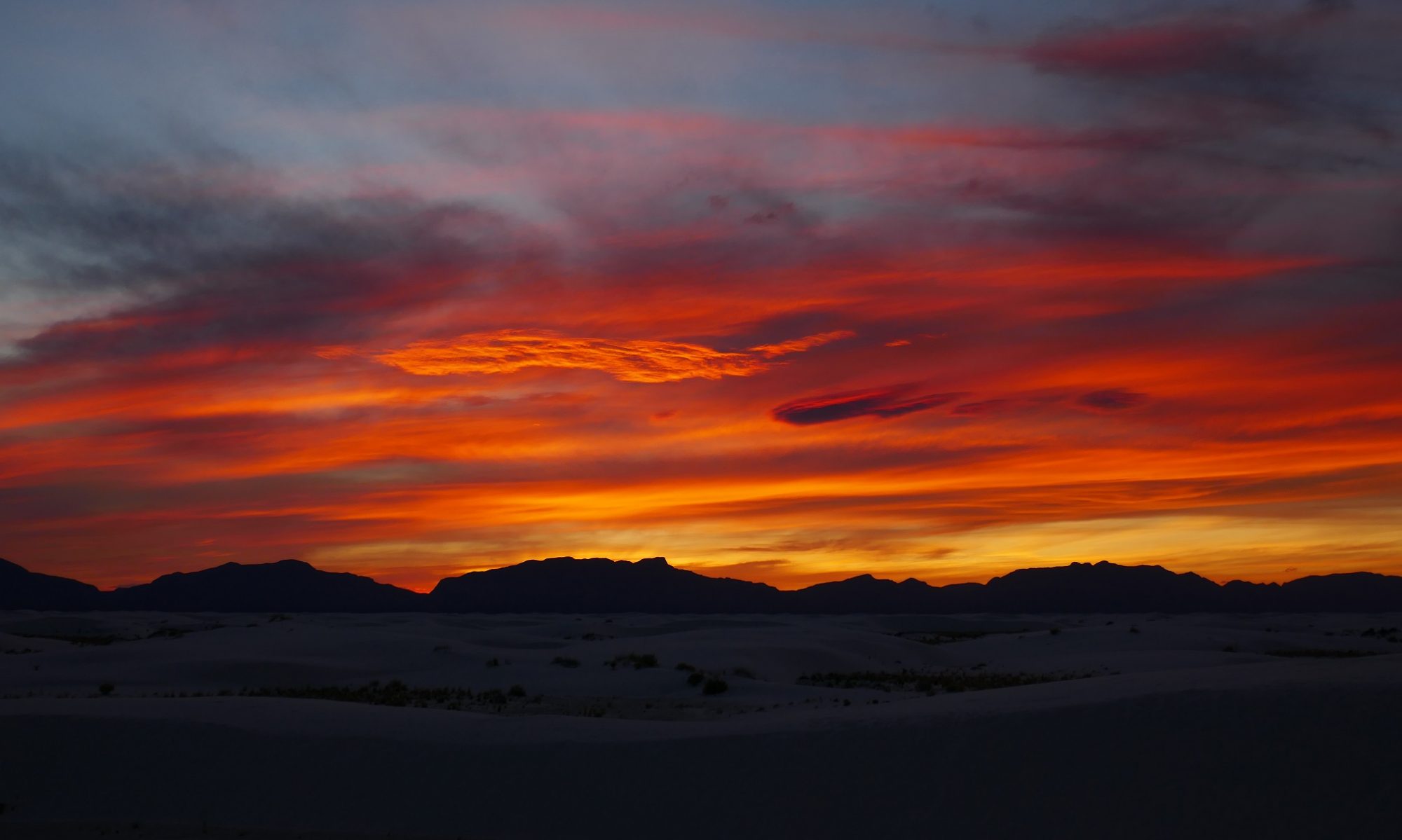

As we travel through life, inevitably we pass through storms, big and small. We may not comprehend why, but just as the two powerful storms that I encountered many years ago paved the way for memorable vacations, the storms in our lives, too, will somehow bring a more beautiful future – if not for us, then for God’s glorious universe.
When you hear the word “storm,” what image comes to your mind? For us in North Texas, the incessant thunderstorms that recently drenched us may come to mind. For my relatives and friends in Semarang, Indonesia, perhaps it is the rainstorm earlier this year that brought flooding to the city. Still, for meteorologists in the US, most likely “storm” conjures up the image of tornadoes and hurricanes that keep them busy throughout the warm seasons.
As for me, the word “storm” always brings to memory two powerful storms that I encountered during our road trips many years ago.
The Dark Thunderstorm of the West Texas Plains
It was Wednesday evening, June 8, 2005. My family and I were on the way to Amarillo, the first leg of what would be a 2,200-mile road trip to Seattle. We left Plano, Texas, at 4 PM, and by the time we passed Wichita Falls around 6:30 PM, ominous dark clouds were floating so low above US Highway 287, we could almost reach them. Remarkably, the lyrics of the worship song “Storms” perfectly describe the scene that day:
The clouds are forming,
Heaven’s roaring,
Can you feel it now?
The storms are breaking out.

Indeed, my wife Lili and I could sense a dangerous thunderstorm brewing, and in that sparse road surrounded by the wide-open plains of West Texas, it was truly a scary feeling; one that I still remember to this day.
Soon, heaven opened up, and thick drops of rain came down furiously. So much poured down that I could barely see anything around me. My minivan crawled to 20 mph (32 km/h), and even then I was praying not to hit anything or end up in a ditch. Lili was hanging on tensely on the passenger seat, at the same time trying to calm down our three little kids in the back seat. It was a long torment, and when we finally passed through the storm and stopped at a Pizza Hut restaurant in Childress after 9 PM, we were exhausted, starving, and relieved all at once.


The Mighty Sierra Nevada Snowstorm
While that West Texas storm was the scariest one, one that pounded us when we were lonely and vulnerable, it was not the most grueling one. That distinction goes to the mighty Sierra Nevada snowstorm that ambushed us on the last week of 1992.
It was our first Christmas holiday in the US, and Joseph, Lili’s brother, asked us if we wanted to join him and his wife for a week vacation in San Francisco and Reno, Nevada. After a couple days in SF, we left for Reno at 2 PM on a bright, sunny afternoon. “We should be in Reno by 6 PM, perfect timing for dinner!” we thought. We were in for a big surprise; it would take much longer that night to cross the 7,056-foot-high (2,151 m) Donner Pass between California and Nevada.

The first half of the trip was all well. But as Interstate Highway 80 started climbing up Sierra Nevada mountain range east of Sacramento, small snow flurries started falling. At some point there was a police presence and a sign saying, “Tire chain required!” For the unprepared folks like us, there were people selling and installing them on the roadside. So, we paid for a set and continued our journey. I was driving up to that point, but Joseph took over because having just come from Indonesia, a tropical country, I had never driven in the snow before.
As we climbed higher, the snow fell faster, and the traffic soon came to a crawl. And “crawling” was how we crossed the mountain all night long in our rental Ford Taurus. The whole interstate highway was choked with vehicles, creeping like a long flickering snake amidst the fierce snowstorm. We finally reached Reno at 6 AM, 16 hours after we left San Francisco. What a relief it was. Thank God that our 6-month-old daughter slept peacefully in her car seat through the whole thing.


As we travel through life, inevitably we pass through storms, big and small. When I started contemplating this article, my days were calm and sunny. Then out of nowhere, two successive storms hit me. First, my employer told me that somebody had applied for an unemployment benefit using my name. Then, before my mind could fathom the scale of the identity theft, came the news that my mom in Indonesia had slipped and broke her ankle. It felt like I drove through the West Texas thunderstorm and the Sierra Nevada snowstorm at the same time.
Storms of Grace
Much has been written about the meaning of trials in our lives and God’s role in it. One metaphor that resonates with me is Thomas Aquinas’ depiction of God as the Great Artist (e.g., a sculptor or a painter) who constantly works on His marvelous creation. But since it is spring now, the planting season, I’d like to think of Him instead as a Master Gardener. The Lord is busy planting new flowers, pulling out weeds, fertilizing – everything to make His garden more beautiful. And each of us is a little plant in that garden; a garden that spreads across the infinite space and time.
Often, the Lord gives us nothing but good compost, mulch, and water. We grow left and right, rub elbows with the plants next to us, and flaunt our showy flowers. Inevitably, though, as all good gardeners do, the Lord comes to prune us. He may trim some of our branches here and nip our flowers there, but every now and then, He chops everything almost to the ground until we have nothing to show anymore. He may even dig us up from the ground and move us to another place. Ouch!
As a mere little plant in God’s boundless garden, it is often difficult for us to see the meaning of His “gardening” actions. In his book “The Strangest Way: Walking the Christian Path,” Bishop Robert Barron wrote that throughout the Bible, the sacred authors had always connected human to the cosmos. Cosmic components (planets, stars, animals, trees, etc.) are also prominently displayed in the great Gothic cathedrals. The message is that everything in the universe is moving under the direction of the Divine Logos (Mind). As such, my mission is inextricably connected to the “missions” of the other living creatures, from humans to angels to oak trees, and yes, even to the rabbits that keep plundering my flower bed. In some mysterious ways, God’s actions on me beautify a plot in His garden and enhance the garden’s overall majesty.

Seen in this light, every life trial serves a purpose. How often do we hear that someone’s suffering, even death, becomes the catalyst for a positive change? I was reminded of that as I watched a documentary movie about Fr. Stanley Rother. Fr. Rother, the first American martyr, was murdered in Santiago Atitlan, Guatemala, in 1981. The parish of Santiago Atitlan had been founded in 1547, but for more than 400 years it didn’t produce a single priest. Yet, Fr. Rother’s death brought a profound renewal, and by 2018, the community had churned out nine priests with seven more candidates in the seminary. “It is remarkable,” I thought, “that the sweats, tears, and blood of our life trials do water the garden the God.”
"No faith is so precious as that which lives and triumphs in adversity. Faith untried may be true faith, but it is sure to be little faith, and it is likely to remain dwarfish so long as it is without trials. Faith never prospers so well as when all things are against her: tempests are her trainers and lightnings are her illuminators."
- Charles Spurgeon (English Baptist preacher, 1834-1892)
While I may not understand God’s deeds or plan, it is easy to imagine that when the Lord is working on me, He is also the closest to me. Hence, those moments provide an exceptional opportunity for me to listen closely to Him. His whisper would come through some unexpected means – like Benny, a collegemate whom I met again last month after 33 years. He told me how a knee injury had forced him to stop focusing on building his physical prowess and to rebuild his close relationship with Christ instead – something that he used to have in college.
This realization of God’s closeness to me, along with the conviction in His masterful plan, helps me see the storms in my life as the “downpours of grace.” Just as the West Texas and the Sierra Nevada storms preceded two memorable vacations, so too our life storms bring a more beautiful future – if not for us, then for God’s garden.
"They are never alone who suffer
Though no friends stand at their side
Yet tenderly on them from Heaven falls
The glance of the Lord Crucified."

- from the Dedicated Days booklet by The Leaflet Missal Company
References
- “Storms” song by Still Morning worship band is available at https://www.stillmorningmusic.com/music and from all major digital music platforms.
- “The Strangest Way: Walking the Christian Path” book by Bishop Robert Barron is available from https://www.wordonfire.org/study-programs/untold-blessing/ as part of “Untold Blessing: Three Paths to Holiness” study program.
- “An Ordinary Martyr: The Life and Death of Blessed Stanley Rother” video is available at https://youtu.be/hsOvNtoZVzc
 REFLECTIONS ON LIFE, WORK, AND FAITH IN THE 21ST-CENTURY AMERICA