
Beauty seems to be easily found in our summer vacation spots, but the story of Joe – the first resident of Joseph House, a project to help ex-prisoners reintegrate into the society in Tallahassee – reminded me that our lives could be much more refreshing if we relearn to marvel at nature close to home. □
As I opened Give This Us Day, my daily reading book, in our beach condo in Destin, Florida a few weeks ago, I came across a short story on St. Alphonsus Liguori. He was an extraordinary man who founded the Congregation of the Holy Redeemer in 1732, wrote more than a hundred books, and was later named a Doctor of the Church. At the end of the story, there was a quote from him:
“When we see a beautiful object, a beautiful garden, or a beautiful flower, let us think that there we behold a ray of the infinite beauty of God, who has given existence to that object.”
As we were surrounded by beauty in Destin, I couldn’t help but think that this was the perfect quote for the occasion. The beauty was everywhere: the emerald and translucent sea, the infinite white-sand beaches, and the silvery fish swimming gracefully in the ocean. I posted that quote on Instagram, adding a wish that everybody might find beauty in their own summer vacation spots. But a touching story that I heard two days later reminded me that beauty is always near us – if we are willing to keep our sense of wonder.

A day before we headed home, we attended a Saturday vigil mass at the Resurrection Catholic Church on the west side of town. It was a hexagonal building with glass windows all around, and the late afternoon sunlight made the worship space bright and airy. Fr. Tom Guido and his beloved Golden Labrador, Grace, were there to greet the worshippers warmly. On that day, though, they had a guest priest – Fr. Dustin Feddon from Tallahasse – to lead the mass.
In his homily, Fr. Feddon told us about Joseph House, a recent ministry of the Diocese of Pensacola-Tallahassee dedicated to helping ex-prisoners reintegrate into society. Towards the end, he shared eagerly that they had admitted their first resident, Joe. “At the age of 13,” Fr. Feddon said, “Joe was sentenced to life in prison without parole.” Joe ended up spending 28 years in prison, five of which in solitary confinement, until the US Supreme Court overturned his sentence. (Joe’s legal team and Bishop William Wack believe he was wrongly convicted.) “But Joe is thriving now, adjusting to the normal life,” Fr. Feddon continued, “and so are the squirrels in Joseph House’s yard.” Apparently, during his time at the Joseph House, Joe grew to love feeding the nearby squirrels and other animals.
Those words struck me. I went all the way to Destin to find beauty, but Joe found it in his backyard. Yes, it is easy to find God’s beauty in our scenic summer vacation spots, but can we still find it in our everyday surroundings? After all, summer only comes once a year.

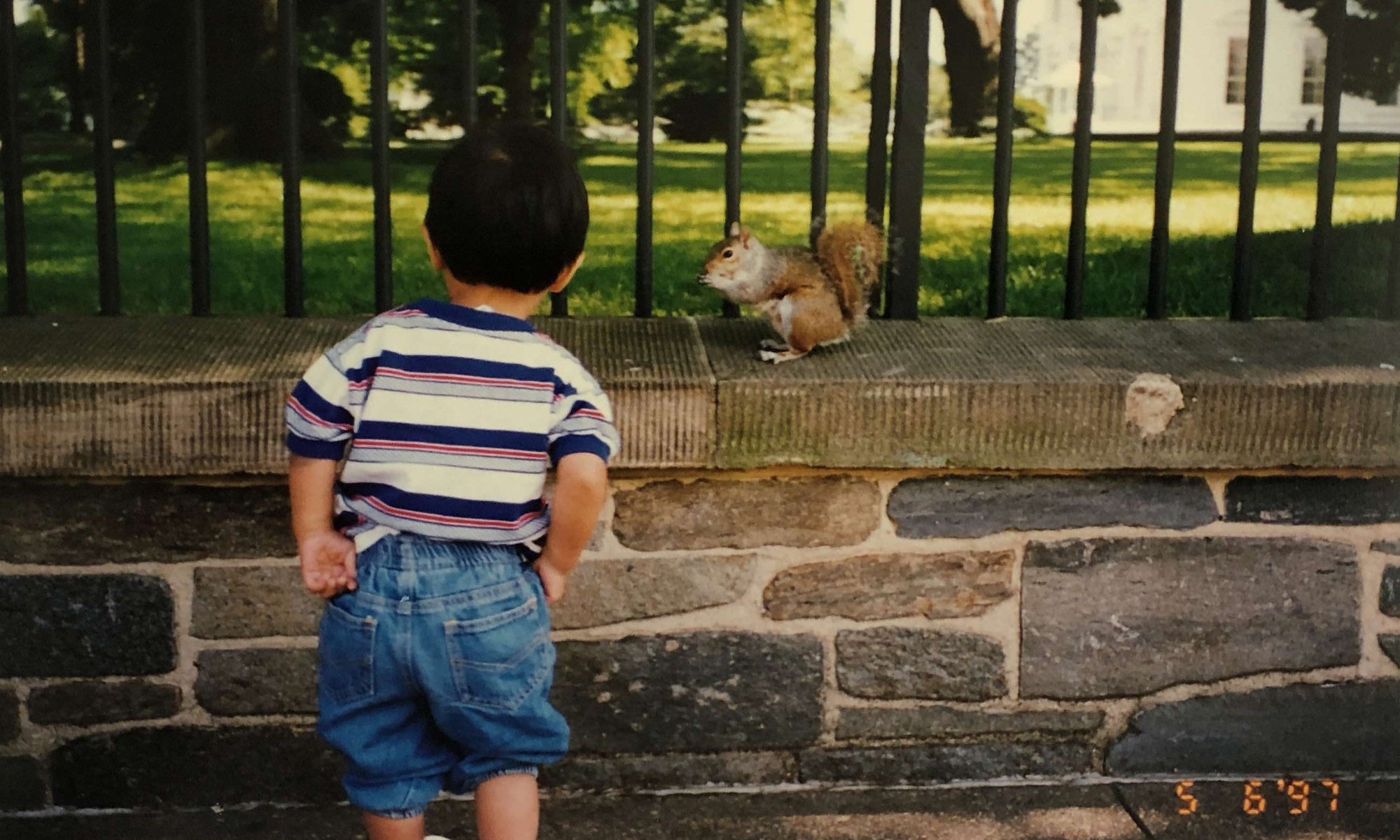
The irony is, squirrels used to be cute (or at least interesting) to me. When I came to the US 27 years ago, seeing squirrels running around freely at the University of Texas at Austin campus was fascinating. My wife Lili and I used to take our then-toddler daughter Dea to feed them. (We came from Java, the most populous island in the world, where there was barely enough space for people in the urban areas, let alone for squirrels or other wildlife.)
Later, at our new house in Plano, wild rabbits charmed me. Along with squirrels, these little fluffy cottontails (as they are also called) were everywhere: in our yards, along the jogging trail, and in the park behind our kids’ elementary school. Sometimes they even gave birth to baby bunnies in our backyard. But as time has gone on, I find that I hardly pay attention to them anymore.

As we become familiar with something, we slowly take it for granted until eventually, the thing ceases to excite us at all. Our capacity to wonder also seems to diminish as we age and prosper. (Even Bevo, our aging cockapoo, seems to be less interested in squirrels and rabbits nowadays.) But just as we are refreshed after a vacation, letting a few everyday living things stimulate our senses will help keep our otherwise-mundane days fresh. Unknowingly, Lili is doing just that this year; she planted a few pepper plants in spring and is now excited with their progress every day.
I wonder if the reason Jesus said that the Kingdom of God belonged to little children was that, by nature, they marveled easily at God’s creations around them.

In his aptly-titled book A Touch of Wonder, Arthur Gordon offered a method to revive our sense of wonder. Say to yourself, he wrote, “Suppose this were the only time. Suppose this sunset, this moonrise, this symphony … suppose you would never experience these things again!” His words echoed my father’s: “Everything happens exactly only once in our lives.”
Or, we can simply remember Joe’s story and say to ourselves: Suppose I haven’t seen this thing for 28 years …
Further Reading
- To read more about Joseph House and Joe, visit Joseph House website. They were also featured in two articles from Crux and Tallahassee Democrat.
- From her more than 30 years of research on the effects of nature on humans, Professor Ming Kuo from the University of Illinois at Urbana-Champaign has found that contacts with nature have significant and concrete benefits for us, from enhancing our social and psychological functions to improving our physical and mental health. Listen to her interview at NPR Hidden Brain podcast: You 2.0: Our Better Nature
- To see cute photos of the squirrels at UT campus and their Yearbook, visit Squirrels of UT
 REFLECTIONS ON LIFE, WORK, AND FAITH IN THE 21ST-CENTURY AMERICA