

A story about the angels in our lives, as illustrated by three kindhearted Americans who helped and welcomed me into this great country many years ago. □
2019 is special year for me. I turned 54 this year, and I arrived in the US 27 years ago this week – meaning I’ve now spent half of my life in Indonesia and half in America. As I hit this milestone, I can’t help but remember the kindhearted Americans who helped me get to this dreamland and welcomed me with open hearts. There are so many of them which makes it impossible for me to mention them all, but in this article, I’d like to pay tribute to three people from my early days in the US.
Dr. Jack Prince – A Global Missionary Educator
On Monday, December 10, 2018, my wife Lili and I attended a memorial service for Dr. Clarence E. Prince at Westminster Presbyterian Church, a beautiful place of worship surrounded by oak trees, in the west side of Austin. Dr. Prince – or “Jack,” as he was known to the people closest to him – passed away on November 19, one month shy of turning 90 years old. As a young Marine, he served in the Korean War. After his discharge, he went back to school, eventually earning his PhD in electrical engineering from the University of Texas at Austin (UT). Korea must have left an indelible impression in him because he later returned there with his wife Moneta, and altogether they spent 20 years there as missionary educators. Along the way, he helped established a college (now Hannam University) in Daejeon and served as the Dean of Engineering and Vice President at Soongsil University in Seoul. When he felt that the higher education system in Korea had become well-developed, he and Moneta moved to serve in a new country, Indonesia. It was then that I met Dr. Prince.

I was a sophomore at Satya Wacana Christian University in Salatiga, a small mountain town in Central Java, when Dr. Prince (and Mrs. Moneta) arrived there in 1984. In the subsequent years I took a few classes from Dr. Prince, who was highly respected by the students, and remarkably, taught in Indonesian (I learned later that he also spoke Korean fluently).
After a brief stint in the oil fields, I started applying to graduate schools in the US in the fall of 1991. Dr. Prince wrote a recommendation letter for me, and since it was the only reference with a PhD from an American university, his was an important one. Two universities accepted me, but my top choice, Dr. Prince’s alma mater, UT, didn’t. I desired to go to UT because I considered it as the “best buy” (i.e., the best graduate school that I could afford). Moreover, Lili’s younger brother was living in Dallas, and we knew it would be helpful to live not too far from him.

In early 1992 I drove back to Salatiga to meet Dr. Prince; I still remember sitting in his small, on-campus house and explaining my predicament. Dr. Prince immediately picked up a pen and wrote a personal letter to his close friend, Dr. Elmer Hixson, an electrical engineering professor at UT. “It would be a pity for Rubianto to go to this rival university instead of to UT,” he wrote. A short while later, I received my acceptance letter from UT.
Dr. Elmer Hixson – A Lifetime Teacher and Runner
In August 1992 I started my master’s program at UT. Dr. Hixson took me under his wing regardless of the fact that I was more interested in digital signal processing than acoustics, which was his specialty. Simply put, I was lost in that first semester. Everything was brand new to me: new country, new culture, new system. Dr. Hixson, though, kindly helped me navigate life inside and outside campus, even giving me a desk in the corner of his room on the sixth floor of the electrical engineering building. It was a great perk for a foreign student with a modest budget: it meant I had a place to keep the lunch box that Lili often prepared for me.
In my second year Dr. Hixson gave me a teaching assistant position, and with it came a stipend, free tuition, and health insurance – all of which were tremendous help for me, Lili, and our one-year old daughter Dea. We were especially grateful for the latter as it meant we didn’t have to wait for hours at the public health clinic whenever one of us needed to see a doctor.
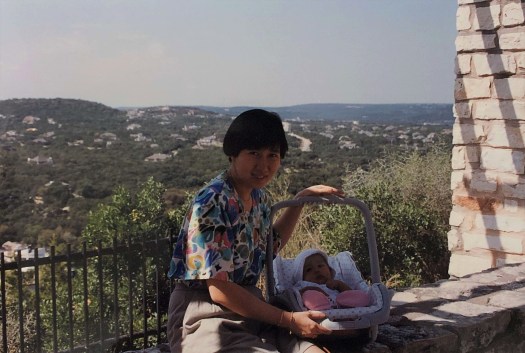

Dr. Hixson was also an avid runner. He started running in 1964, and while I was at UT, everyday around lunch time Dr. Hixson would leave his office and run three to six miles, rain or shine. He also ran many marathons and half-marathons. I can even remember cheering for him along the bank of Colorado River near my apartment as he ran the 10-mile Taco Trot, a race that he and his friends founded in 1981 “in order to enjoy Thanksgiving dinner fully.”
All in all, Dr. Hixson taught at UT for 50 years. He passed away on February 10, 2011, at the age of 86. I was grateful to meet him and his wife Betty at their house a year before his passing while taking some business courses at UT.
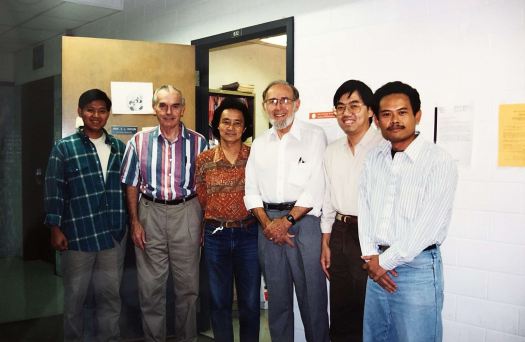
In 1994 Dr. and Mrs. Prince returned to the US and settled in Austin. My family visited them at their house near UT campus a couple times. Dr. Prince maintained his friendship with Dr. Hixson throughout the years. “Elmer fixed the acoustic problem in my church,” Dr. Prince told me when I last met him at Dr. Hixson’s funeral service.
Doug Dartez – A Talented and Kind Gardener
Fast forward to July 1995. I got a job at Nortel early that year, and we decided to buy a house a few months afterward. To save money, we bought a small house in Frisco – a far-north suburb of Dallas, 18 miles away from my office. Back then, Frisco was still a sleepy town with 13,000 residents, and it was a predominantly white community. Asian Americans like us were rare; probably less than 2% in total.

We moved into our new house on Saturday, July 29, 1995, and just two days later Lili delivered our second child, Martin. Between moving into a new house and having a new baby (plus a 3-year old daughter), things were crazy for us. This was our first house, and being a first-generation immigrant, I had no idea what owning a house in American suburb entailed. I had no equipment to maintain the yard: no lawn mower, no trimmer, no edger – and certainly no time to buy them. Within two weeks, the Bermuda grass on our lawn was more than a foot high.
One day we suddenly heard a loud noise in our backyard. To our shock, we saw our next-door neighbor Doug mowing our lawn. I ran outside and tried to stop him. While I appreciated his help, I told him, “No, you don’t need to do it.” But it was to no avail. He continued mowing my whole yard! And that was not the end of it. A week later he did it the same thing!

Doug Dartez and his wife Kim became our good neighbors for the next four years. Their beautiful daughter Kristen was a friend to our kids (see top photo). Doug was a talented and passionate gardener, and his yards and flowerbed were immaculate: neat, clean, and beautiful. But I didn’t appreciate his talent fully until they moved out in 1999. It was obvious that the new homeowner had a really hard time maintaining the splendor of the garden.
I lost contact with Doug after he moved, but after 20 years, I was glad to connect with him again via LinkedIn recently.
I am not Utopian, and I know that prejudice and stereotyping exist. I remember one time in those early years in Frisco when a young, white cashier in a department store mocked me and Lili by speaking in “funny” Chinese. (He must have thought we were from China, or that all Asian-looking people were Chinese.) In another time and place, my workmate Manoj and I were assigned to do drive testing to check the cellular coverage in rural Missouri. As we stopped aside on a two-lane country road and took pictures, a man in a truck slowed down, lowered his window, and while looking at us suspiciously, growled, “What are you guys doing here???”

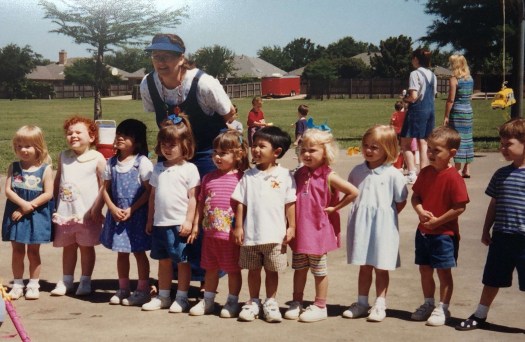
Those occasions are far and few in between, though, and they are easily drowned out by countless of positive experiences, even in rural America. And I am not the just lucky one: my good customer Mohamed, for example, who came from North Africa 30 years ago, told me over dinner recently that he could only recall one instance where he felt he was racially discriminated against.
Amidst the sobering news of the increased activity of white nationalist and anti-immigrant groups, my personal experience brings the much-needed solace that those people are the exception, not the rule. In the international management arena (which I studied in my doctoral program), Americans are often characterized by their openness to innovation, change, and foreigners. My 27 years in the US have confirmed that portrayal; and now that I am an American, it is incumbent upon me to keep that spirit alive.
PS: Who are the angels in your life? Please share it in the comment box below.
 REFLECTIONS ON LIFE, WORK, AND FAITH IN THE 21ST-CENTURY AMERICA