

□ An essay on light, vision, and leadership, and a tribute to Antoni Gaudi and all brave souls who shine the light on the path of life less cluttered with worldly noises and trifles. □
At the end of February 2019, I attended Mobile World Congress (MWC), the biggest international wireless trade show, in Barcelona, where the buzz was all about 5G wireless technology. We, the wireless professionals, have been talking about it for two years, but this time it felt real: Verizon will launch 5G mobile service in Minneapolis and Chicago in April (with 28 more cities coming in 2019), and other wireless operators will follow soon after [1].
I have attended MWC seven times, but this time around, my wife Lili came to join me in Barcelona after the show ended. We spent four days exploring the city together with the luxury of beautiful weather throughout the week. We visited the must-see tourist attractions in Barcelona, including, of course, La Sagrada Familia (The Holy Family), the famous, still-under-construction Catholic church. The Basílica i Temple Expiatori de la Sagrada Família, as the church is officially called, is considered the masterpiece of the great Catalonian architect Antoni Gaudi.

Although this was my second time visiting the church, I was still filled with awe upon entrance. It was around 3:30 PM on a breezy and bright Saturday, and the sunray filtered into the nave through the yellow, magenta, and turquoise stained-glass windows that adorn the entire western wall. The whole sanctuary was set ablaze with warm-colored speckles, creating a radiant glow around each and every visitor. It was a majestic sight, and I couldn’t help but think about light, vision – and leadership.

Light and vision are closely intertwined, of course; without light, we can’t see anything. (Anyone who has been in a pitch-black underground cave can attest to that.) When God created the universe, the first thing that He did was create light. Without it, Adam and Eve – and all their descendants – wouldn’t have been able to see the beauty of God’s subsequent creations. “Of all the senses, sight must be the most delightful,” said Helen Keller [2] – and I have to agree with her. The invention of electricity and light bulbs – which have helped people to see better and longer everyday – have had an arguably tremendous impact on humanity.
Yet vision goes beyond what the eyes can see. Dr. James Kouzes and Dr. Barry Posner, who have studied leadership for thirty years, defined vision as “an ideal and unique image of the future for the common good” [3]. It is a picture in the mind’s eye of an exciting future with ennobling possibilities. They wrote that the capacity to develop a vision and inspire others to follow it is one of the most important traits of a leader. In a way, leaders are visionaries: they can see an image of an extraordinary tomorrow that goes beyond simply their own personal good.
Josep Maria Bocabella was such a leader. Even though he was just a layman, an owner of a religious printing and bookshop in Barcelona, he had a vision of building a Catholic expiatory temple dedicated to the Holy Family after his pilgrimage trip to Rome [4]. He founded the Association of the Devout of St. Joseph in 1866 which collected donations to buy a land for the temple and pay for its construction. He then hired Antoni Gaudi in 1883 after the first architect resigned just a year after La Sagrada Familia construction began [5].

Going back to Drs. Kouzes and Posner, they further wrote that leaders show commitment to their visions (and their beliefs and values) through their daily actions [3]. I doubt leadership training existed in his time, but it is obvious that Antoni Gaudi understood this well. He was convinced that nothing of value can be achieved without sacrifice, and so, despite his fame and achievements, lived a simple life of prayers and material detachment. And as he got older, he continued to live even more frugally [6].
Gaudi was a devout Catholic who loved the Liturgy, and he found a spiritual peace in his faith. The last ten years of his life were dedicated to building “the Cathedral of the Poor” as La Sagrada Familia was commonly known. His wish to die among the poor was fulfilled when he was struck by a tram on June 7, 1926, on his daily walk to St. Felip Neri church. Looking like a beggar because of his shabby clothes, he was taken to a pauper’s hospital where he died three days later.
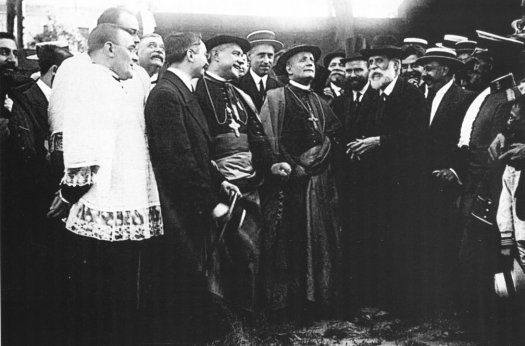
Both Josep Maria Bocabella (died in 1892) and Antoni Gaudi were buried in the crypt of La Sagrada Familia church. Gaudi’s beatification process was started in 2003 and is in progress. The request to open the beatification process for Bocabella was presented to the Archbishop of Barcelona on January 9, 2013, though I’m not sure where the process is now.
While many leaders inspire people to do more, in this era of endless information and entertainment (which is poised to stream even faster with 5G), we desperately need a vision on how to do less. Or, more precisely, how we can do fewer unimportant, transient things in order to focus on the important, eternal ones. St. Katherine Drexel said, “It is for each of us to learn the path by which He requires us to follow Him, and to follow Him in that path.” The implication here is that each of our paths is unique, and much time is required to find it. For Gaudi, his path was through his architecture and through building magnificent buildings, but to find that avenue, he willingly lived a life less cluttered with worldly distractions.
And so, as we are about to finish the Lent season – a season that invites us to renew our hearts and to grow closer to God – I want to give a shout-out to all brave souls who shine the light on the path of life less cluttered – people such as my son Austin and his friends who are doing the Exodus 90 program. You may not know it, but you are leaders who show me and others a vision of lives better lived with less. You are an inspiration because you have the courage to sacrifice material comforts to gain spiritual ones. You reveal a new path for us: a path more beautifully lined with the essentials and less littered with the trivialities. You, through your own actions, invite us to spend more time discerning what God created us to be. May your light shine brightly for the others to see the path less cluttered.
Exodus 90 is a 90 day Lenten practice of asceticism and prayer geared towards a looking-inward to Jesus and the interior life! Practices include abstaining from social media, no hot showers, and no snacking in between meals (along with many others). Truly though, the idea is not to simply abstain from these, but to instead spend that time and energy towards the spiritual life and closer union with Christ.
Further Readings
- Fisher, T. (2019, March 15). When is 5G coming to the US? (Updated for 2019). Retrieved from https://www.lifewire.com.
- com. (2019, January 16). Helen Keller biography. Retrieved from https://www.biography.com.
- Kouzes, J. M. & Posner, B. Z. (2007). The leadership challenge (4th). San Francisco, CA: Jossey Bass.
- José María Bocabella. (n.d.) Retrieved March 20, 2019 from Wikipedia.
- Gaudi & Barcelona Club. (n.d.) The “Sagrada Família.” Retrieved March 20, 2019 from gaudiclub.com.
- Antoni Gaudí. (n.d.). Retrieved March 20, 2019 from Wikipedia.
- Fidgen, J. & Kremer, W. (2015, May 11). Will Gaudi be made a saint? Retrieved from https://www.bbc.com.
- Tarragona, J. M. (2013, January 13). They want to beatify Josep Maria Bocabella. Retrieved from http://www.antonigaudi.org.
 REFLECTIONS ON LIFE, WORK, AND FAITH IN THE 21ST-CENTURY AMERICA